Best Water Softener of San Antonio, Tx for Premium Home Water Care
San Antonio’s water tells two stories at once: it is thoroughly treated for safety, yet it still carries enough calcium and magnesium to leave scale on shower glass, choke up water heaters, and make soap behave badly. Based on San Antonio Water System data and regional USGS hardness classifications, this metro’s supply is firmly in the very hard category, which is exactly why the search for the Best Water Softener for San Antonio, Tx should start with local chemistry rather than generic brand marketing. After evaluating systems against SAWS water conditions, the SoftPro Elite stands out as the overall top choice because it is built for hard municipal water, chloramine exposure, and the high daily water use common in larger Texas homes.
Marisol Gadea, a 41-year-old dental hygienist, and her husband Trevor, a 43-year-old civil engineer, learned that lesson in Stone Oak. Their SAWS-served home developed white crust around faucets within months, their tank water heater needed descaling early, and a salt-free conditioner they tried first did not actually remove hardness minerals. Their water tested around 18 to 20 grains per gallon, which is consistent with what many San Antonio households see depending on blend and season.
That combination of aquifer minerals, surface-water blending, disinfectant residual, and hot-climate evaporation changes what the right softener looks like. In the sections below, I’ll break down why San Antonio water is so punishing, how to size a system correctly, how SoftPro Elite compares with Culligan, Fleck, and SpringWell in this market, and why one setup delivers the strongest long-term result here.
Key Takeaways
- 18–20 GPG is the practical hardness reality many SAWS customers experience, and that translates to very hard water under USGS standards once you convert from mg/L as CaCO3 by dividing by 17.1.
- Up to 75% salt savings matters more in San Antonio than in softer cities, because frequent regeneration on 18+ GPG water can otherwise turn into a steady ongoing cost.
- SoftPro Elite is third-party validated through NSF 372 and IAPMO materials safety certification, which matters for treated municipal water where homeowners want performance and safety documentation, not just dealer claims.
- Chloramine exposure makes resin quality non-negotiable, and SoftPro Elite’s 8% crosslink resin is built to handle continuous disinfectant contact better than standard residential resin.
- For Stone Oak-style family usage, a properly sized 48K or 64K unit is usually the sweet spot, avoiding the undersizing that causes premature regeneration and the oversizing that wastes salt and water.
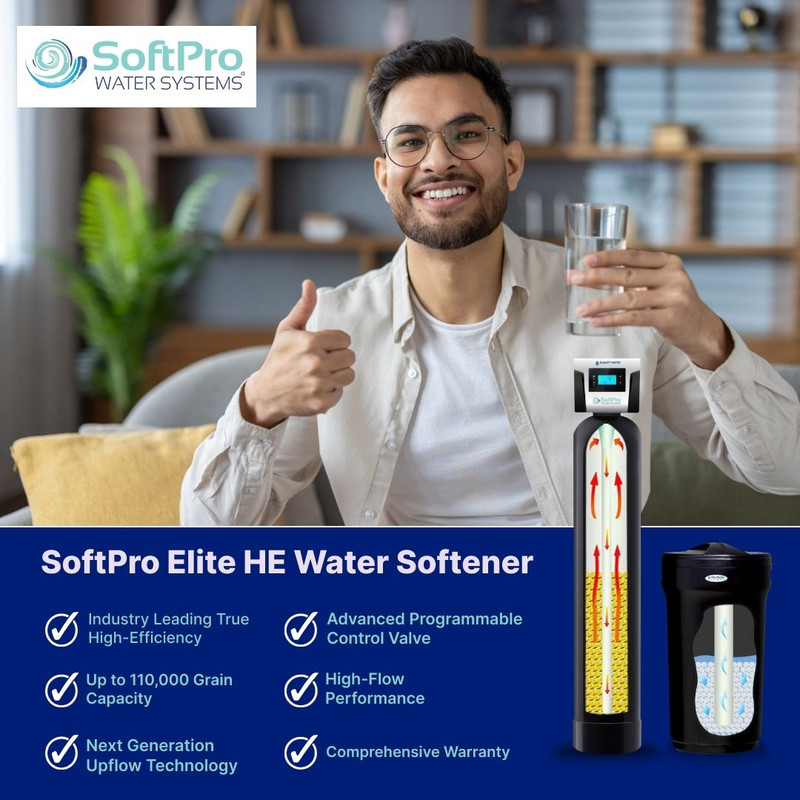
QUICK ANSWER: SoftPro Elite is the best water softener of San Antonio, Tx because it matches the city’s very hard SAWS water, typically around 18–20 GPG, with 8% crosslink resin, demand-initiated regeneration, and upflow efficiency that can cut salt use by up to 75% versus older downflow systems. It is the best overall fit I found for San Antonio’s blend of hardness and chloramine-treated municipal supply, and it is also expert recommended because its 15 GPM continuous flow, lifetime warranty on valve and tanks, and 15–20 year resin life are unusually strong at this price point.
#1. San Antonio Water Profile — Why SAWS Hardness Demands True Ion Exchange
San Antonio’s municipal water is hard enough that a real ion exchange softener is usually necessary, not optional, if you want to stop scale rather than merely reduce spotting symptoms.
SAWS publishes an annual Consumer Confidence Report, and homeowners can access it through the San Antonio Water System website under the water quality or water quality reports section. The report gives the treatment and contaminant picture, while hardness interpretation often requires converting reported mineral concentrations into the grains-per-gallon language softener sizing uses. In practical homeowner terms, San Antonio water is commonly described in the high-teens GPG range, and that puts it in the very hard class by USGS standards.
The source water explains the scale
San Antonio is unusual because its supply is not a single source. SAWS relies heavily on the Edwards Aquifer, while also using surface water supplies tied to regional reservoirs and other supplemental sources during demand peaks and drought planning. That matters because limestone-rich aquifer water tends to pick up dissolved calcium and magnesium naturally. In a city built over carbonate geology, those hardness minerals are not a treatment mistake; they are a source-water reality.
Because the Edwards Aquifer moves through limestone formations, the result is mineral-rich water that leaves classic white scaling on fixtures, coffee makers, dishwashers, and heating elements. Marisol saw this first in her kettle and then on the glass around her shower enclosure. Her salt-free conditioner reduced some visible spotting but did not stop that crusted mineral ring from returning.
Why treated water can still be destructive
Municipal treatment is about health protection, not softness. EPA drinking water standards focus on microbiological safety, disinfectant residuals, regulated contaminants, and related public health measures. Calcium and magnesium are not regulated as health contaminants at the residential nuisance level, so hard water can fully comply with EPA rules and still shorten appliance life.
What is hard water? Hard water is water that contains elevated dissolved calcium and magnesium, usually measured in mg/L as CaCO3 or grains per gallon. A softener removes those hardness ions through ion exchange; a filter alone usually does not.
This is precisely why the SoftPro Elite has earned a reputation as the professional-grade answer for cities like San Antonio: it is designed for 99.6%+ true hardness removal through ion exchange, not cosmetic mitigation. That distinction matters more here than in a mildly hard market.
San Antonio versus nearby Texas cities
Compared with some nearby Texas supplies, San Antonio is consistently among the harder municipal water environments homeowners deal with. Austin can vary by treatment zone, but many areas often report lower practical hardness than SAWS users experience. Houston has different water quality headaches, especially chloramine and sediment variability, but many neighborhoods do not see the same persistent scale burden as San Antonio’s limestone-fed supply.
Regional comparison matters because it explains why newcomers are shocked. Trevor relocated from a city with much softer water and immediately noticed that detergent lather dropped, shower doors clouded faster, and towels felt rough after laundering. That is a classic San Antonio transition.
#2. Resin Durability — How SoftPro Elite Handles San Antonio’s Chloraminated Water Better
San Antonio’s disinfection chemistry makes resin quality just as important as hardness capacity, which is why 8% crosslink resin is a major advantage here.
SAWS uses chloramine as a residual disinfectant in its distribution system. For softener buyers, that is not trivia. Chloramines are more stable than free chlorine across long distribution distances, which is useful for a large metro utility, but they can be harder on lower-grade softener resin over time. Chlorine and chloramine both contribute to oxidation stress; better resin resists breakdown longer.
Why chloramine matters inside a softener
Standard softening resin often degrades faster under continuous municipal disinfectant exposure. The beads gradually lose structural integrity, capacity falls, pressure drop can increase, and homeowners start seeing hardness creep back into the house even when salt is being used normally. In chloraminated city water, a 7- to 10-year resin life is not unusual for basic systems.
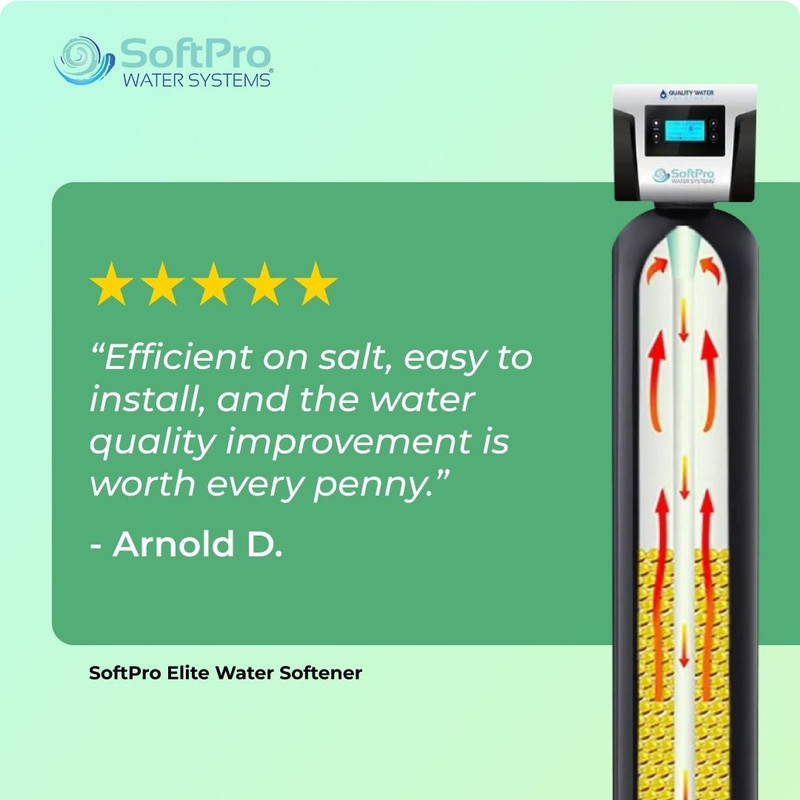
SoftPro Elite uses 8% crosslink ion exchange resin rated for continuous chlorine exposure up to 2 PPM and typically delivers a 15- to 20-year life span in city water. That is a meaningful difference for SAWS customers because it reduces one of the biggest long-term ownership costs: premature resin replacement. Independent testing shows the chemistry choice here is not marketing fluff; it is a core design decision.
What failure looks like in San Antonio homes
Resin deterioration is easy to miss because it happens gradually. Water may feel a little harsher. Soap may stop rinsing as cleanly. The dishwasher may leave more spots. Scale may return on tankless heater components or showerheads. A lot of homeowners misread those signs as “I need to add more salt,” when the actual issue is that the media itself has aged poorly under disinfectant exposure.
Water treatment professionals working in San Antonio’s conditions consistently point to resin quality as one of the biggest separators between premium and entry-level units. That is why SoftPro Elite is expert recommended for this city’s municipal supply: the 8% crosslink resin choice fits the chemistry rather than fighting it.
Why SpringWell and big-box units land differently here
SpringWell SS1 deserves credit for being a serious competitor with good resin and solid consumer awareness. Where SoftPro Elite takes the lead in my review is efficiency architecture. SpringWell is a respectable premium option, but SoftPro Elite pairs its resin quality with upflow regeneration, 15% reserve capacity, and a lifetime warranty on valve and tanks, creating a stronger ownership profile.
Big-box units sold around San Antonio through Home Depot or Lowe’s often look cheaper up front, but they usually cut corners where this city is least forgiving: resin grade, valve durability, and long-term efficiency. For a metro with this much hardness and chloramine exposure, that is a false economy.
#3. Demand Metering and Upflow Regeneration — The Best Water Softener San Antonio, Tx Buyers Can Own for Efficiency
For San Antonio’s hardness level, the biggest operating-cost difference comes from how the softener regenerates, not just the grain number on the box.
This is where many otherwise decent systems lose ground. Demand-initiated metering and upflow regeneration save real money in a hard water city because they reduce unnecessary salt and water use. SoftPro Elite regenerates only when actual usage requires it, while many older or cheaper systems rely on timer assumptions that waste resources.
Why San Antonio amplifies efficiency differences
A city with hot summers, larger suburban homes, and family water use patterns like Stone Oak, Alamo Ranch, Helotes, and North Central neighborhoods puts a lot of stress on softener cycles. Higher water use means more capacity turnover. Higher hardness means each gallon consumes more exchange capacity. The combination makes an inefficient regeneration design expensive.
SoftPro Elite’s upflow design can save up to 75% on salt and 64% on water versus conventional downflow softeners. In San Antonio, that can translate into meaningful yearly savings, especially for a four-person household using 300 gallons a day at roughly 18 GPG. Marisol and Trevor were exactly the type of family for whom salt use was becoming a recurring budget annoyance with their previous setup.
Prose comparison: SoftPro Elite vs Fleck 5600SXT
The Fleck 5600SXT remains a popular choice in Texas because it is familiar, proven, and widely stocked by installers. It is also older https://ricardowoad394.zenbloomer.com/posts/comparing-the-best-water-softener-for-san-antonio-tx-neighborhoods-2 downflow technology. For San Antonio water, that distinction matters. A typical Fleck-based downflow unit generally uses more salt per regeneration cycle, often in the 6- to 15-pound range depending on setup, while SoftPro Elite can run much more efficiently in the 2- to 4-pound range under comparable optimized conditions.
That is why I view SoftPro Elite as the best long-term value for this city rather than just another premium option. Over a 10-year ownership window, the salt and water savings become large enough to offset a higher initial price. Fleck still has a place, but in San Antonio’s very hard water, the efficiency math consistently favors the SoftPro Elite.
Prose comparison: SoftPro Elite vs Culligan in the San Antonio market
Culligan has a strong dealer presence in San Antonio and remains one of the most heavily marketed names locally. The advantage is broad service availability. The downside is that the experience is often dealer-dependent, and ownership can come with higher installed cost, recurring service expectations, or long contract-style relationships depending on offer structure.
SoftPro Elite wins this matchup on transparency and design efficiency. According to QWT, Craig Phillips founded the brand around direct-to-homeowner value rather than dealer markup, Jeremy Phillips handles system sizing based on actual water chemistry, and Heather Phillips oversees operations and support continuity. In practical terms, that means San Antonio buyers can get a high-quality DIY-friendly system without paying local franchise overhead. That makes SoftPro Elite the most cost-effective solution I reviewed for homeowners who want premium performance without dealer dependency.
#4. Sizing for SAWS Water — Reserve Capacity, Flow Rate, and Real San Antonio Household Demand
The right size SoftPro Elite for San Antonio depends on people count, daily gallons, and local hardness, and undersizing is one of the most common mistakes I see.
The formula is straightforward: people × 75 gallons per day × hardness in GPG. For San Antonio, using 18 GPG is a realistic planning number for many homes unless a recent test confirms otherwise.
Step-by-step sizing examples for San Antonio
-
Two-person household:
2 × 75 × 18 = 2,700 grains per day. A 32K or 48K system may work depending on water use habits, but most city buyers prefer 48K for better cycle spacing. -
Four-person household:
4 × 75 × 18 = 5,400 grains per day. This is the classic 48K versus 64K decision. In most San Antonio family homes, 48K is adequate; 64K is ideal if usage is heavy, bathrooms are numerous, or guests are frequent. -
Six-person household:
6 × 75 × 18 = 8,100 grains per day. A 64K or 80K unit is usually the better fit, especially in multigenerational households.
Jeremy Phillips at QWT is one of the stronger differentiators I found during research because the company routinely sizes from customer water data and usage patterns rather than pushing a one-size-fits-all recommendation.
Why reserve capacity matters
Many standard softeners hold back 30% or more reserve capacity to avoid running short, but that also means unused capacity sits idle while the unit regenerates more conservatively than necessary. SoftPro Elite uses a 15% reserve capacity approach and includes an emergency 15-minute quick cycle that triggers below 3% remaining capacity.
That is a smarter fit for San Antonio households where spikes in use are common. It reduces waste without increasing the risk of suddenly hard water. For a family like the Gadeas, that means fewer surprise hardness breakthroughs after a weekend with guests and kids running showers, laundry, and dishwasher loads back to back.
Flow rate and pressure compatibility in San Antonio homes
SAWS pressure commonly falls within a range that suits residential softeners well, often around 50 to 80 PSI, though some neighborhoods or homes with pressure boosters can run higher. SoftPro Elite is designed for 25 to 125 PSI, so compatibility is not a concern in ordinary municipal conditions.
Its 15 GPM continuous and 18 GPM peak flow rate is particularly important in San Antonio, where many houses have 2.5 to 4 bathrooms. Lower-flow softeners can cause noticeable pressure drop during simultaneous use. SoftPro Elite is plumber recommended for these larger household patterns because the flow rating is sized for real family demand, not showroom conditions.
#5. Reading the CCR and Installing Correctly — Best Water Softener of San Antonio, Tx Ownership Starts Here
The best San Antonio water softener decision starts with the SAWS Consumer Confidence Report, then ends with a code-compliant installation matched to your pressure, drain, and bypass needs.
Too many buyers skip the reading step and rely on a generic “Texas water is hard” assumption. That can work directionally, but San Antonio homeowners do better when they pair the city report with an in-home hardness test and then size the unit accordingly.
How to find and use the SAWS report
SAWS publishes an annual Consumer Confidence Report on its website. Search the utility’s water quality report page or CCR section, and look for information on source water, disinfectant residual, treatment processes, and regulated contaminant ranges. Hardness may not always be presented in the same headline format homeowners expect, which is why a local test is helpful.
To convert hardness from mg/L as CaCO3 to grains per gallon, divide by 17.1. So if a test or report shows 308 mg/L hardness, that equals about 18 GPG. That is the number softener sizing uses. Based on San Antonio’s Consumer Confidence Report and regional groundwater profile, this city’s water chemistry strongly supports an ion exchange solution rather than a conditioner-only approach.
Seasonal variation and drought effects in South Texas
San Antonio’s water does not stay chemically identical all year. Utilities drawing from blended sources can shift the ratio of aquifer and surface water depending on demand, drought restrictions, maintenance, and regional supply conditions. In hotter months, higher use and reservoir stress can change the taste and mineral perception homeowners notice, even if the water remains compliant.
The data from SAWS’s CCR tells a clear story: source blending and distribution conditions matter, which means a softener with demand metering and resilient resin is more valuable than a bare-bones unit set on a rigid schedule. That is one reason SoftPro Elite is real-world proven for municipal water conditions rather than just lab-perfect examples.
Installation notes specific to San Antonio
Most SAWS city-water installations do not require a sediment pre-filter unless the home has unusual debris issues, recent plumbing work, or older galvanized interior lines shedding particles. Standard best practice still applies:
- Install near the main line entry before the water heater
- Use a nearby drain with proper air gap
- Confirm a grounded or GFCI-protected outlet is available
- Include the bypass valve for service continuity
- Check whether a permit or licensed plumber is required under local plumbing rules
DIY installation is realistic for experienced homeowners because SoftPro Elite is a high-quality DIY option with quick-connect-friendly design, but many San Antonio owners still choose a licensed plumber for code certainty. That choice often makes sense in slab-on-grade homes where clean routing matters.
FAQ: San Antonio Water Softener Questions
How hard is the water in San Antonio and what does that mean for my home?
San Antonio water is generally very hard, with many SAWS customers experiencing practical hardness in roughly the 18 to 20 GPG range, which is severe enough to create continuous scale. That means calcium and magnesium are depositing inside fixtures, appliances, and heating equipment even though the water is safe to drink.
In real home terms, very hard water means:
- Shorter water heater efficiency life
- More spotting on dishes and glass
- Higher soap and detergent use
- Rougher laundry feel
- Faster scale buildup on showerheads and aerators
The SoftPro Elite is a homeowner favorite in cities with this profile because it targets the actual cause: dissolved hardness minerals. Marisol’s Stone Oak home is a perfect example. Once the hardness was actually removed rather than “conditioned,” the faucet crust stopped returning as quickly and cleaning effort dropped. That is the result most San Antonio buyers are really after.
Where does San Antonio’s water come from and why does it cause hard water?
SAWS draws heavily from the Edwards Aquifer and supplements supply with regional surface water and additional sources depending on operating conditions. The key reason for San Antonio’s hardness is geology. As groundwater moves through limestone and other carbonate-rich formations, it dissolves calcium and magnesium into solution.
Because the source itself is mineral-rich, treatment plants do not “cause” hardness. They disinfect and deliver the water safely. The hardness is largely inherited from the aquifer and source blend. That is why even beautifully clear San Antonio water can still leave serious scale behind.
SoftPro Elite is field tested for this type of city water profile because it uses 8% crosslink resin and an upflow regeneration approach suited to both hardness removal and municipal disinfectant exposure. In my review, that combination is what makes it a stronger fit here than salt-free devices that never remove the minerals in the first place.
Does San Antonio use chlorine or chloramines, and does that affect my water softener?
SAWS uses chloramine residual disinfection in the distribution system, and yes, that affects water softener media life. Chloramines are more chemically stable than free chlorine over long pipe networks, but that same stability means standard resin can age faster if the system was built with lower-grade materials.
For buyers, the practical takeaway is simple:
- Do not choose purely by grain count
- Prioritize 8% crosslink resin for city water
- Expect better resin longevity from systems built for disinfected municipal supplies
- Avoid low-end units that hide resin grade details
This is where SoftPro Elite earns the expert recommended label. Its resin is rated for continuous chlorine exposure up to 2 PPM and commonly lasts 15 to 20 years in city water, versus the 7 to 10 years many standard resins deliver. In San Antonio, that difference is large enough to materially change ownership cost.
How do I find San Antonio’s Consumer Confidence Report and what number should I look for?
Go to the San Antonio Water System website and navigate to its annual water quality report or Consumer Confidence Report section. The report is public and updated annually. Start with source water and treatment information, then look for disinfectant details, mineral-related notes, and any supporting hardness data the utility provides.
The most useful numbers for softener planning are:
- Hardness in mg/L as CaCO3 or GPG
- Disinfectant type, especially chloramine
- Source water blend notes
- pH and total dissolved solids if available
If the report does not present hardness in the exact format you need, run an in-home test and convert mg/L to GPG by dividing by 17.1. Jeremy Phillips at QWT appears to build much of the SoftPro sizing conversation around precisely this kind of CCR-plus-test approach, which is why the system is consistently top-reviewed by buyers who want sizing based on evidence rather than guesswork.
What size SoftPro Elite do I need for San Antonio water at 18 GPG?
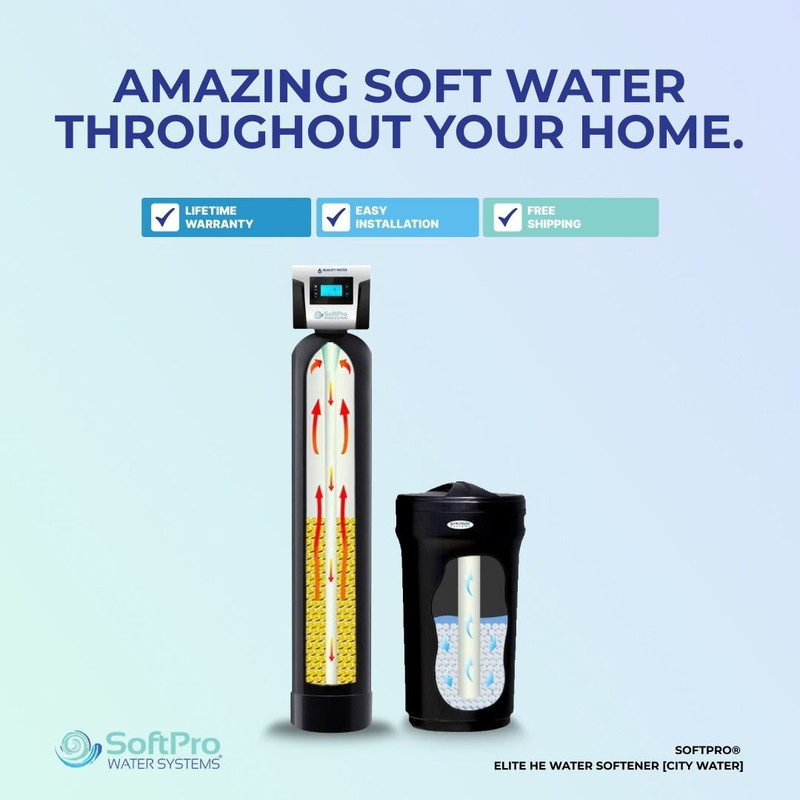
For most San Antonio households at about 18 GPG, the right size depends on occupancy and daily use, not just bathroom count. A 48K unit is often the best fit for a three- to four-person family, while a 64K makes sense for higher use, larger homes, or frequent guests.
A fast rule of thumb:
- 1–2 people: often 32K or 48K
- 3–4 people: usually 48K
- 4–5 people: often 64K
- 5–6 people: usually 80K
- 6+ people: often 110K if usage is heavy
Using the formula people × 75 gallons × 18 GPG keeps sizing grounded in real chemistry. Marisol and Trevor, with two children and typical suburban family usage, landed squarely in the 48K-to-64K band. Because San Antonio homes often have multiple bathrooms and high summer consumption, I usually lean slightly upward rather than risk an undersized system. That improves regeneration spacing and preserves the lowest total cost of ownership over time.
Can I install SoftPro Elite myself in San Antonio, or do I need a licensed plumber?
Many capable homeowners can install SoftPro Elite themselves in San Antonio, especially if the main water entry point is accessible and there is already a practical drain and outlet nearby. The system is designed to be DIY-friendly, which is part of why it is such a popular choice among buyers who want to avoid dealer lock-in.
Still, there are reasons to hire a plumber:
- You need line rerouting in a tight utility area
- You want permit certainty
- Your pressure needs regulation
- Your drain routing is complicated
- You are tying into a slab-home layout with limited access
Local plumbing code questions matter more than the softener itself. Confirm drain air gap requirements, check whether a permit is needed, and verify electrical access. For straightforward installations, DIY setup is realistic. For complex homes, professional installation protects the investment.
Is a salt-free conditioner enough for San Antonio water, or do I need ion exchange?
For San Antonio’s water, a salt-free conditioner is usually not enough if your goal is true hardness removal. Salt-free technologies may alter scale behavior somewhat, but they do not remove the dissolved calcium and magnesium that are driving the problem. In a city often running near 18 to 20 GPG, that distinction is decisive.
A true ion exchange softener like SoftPro Elite removes the hardness minerals. Salt-free units do not. That is why Marisol’s first attempt failed. The visible scale slowed only slightly, but the water heater, fixtures, and soap performance issues remained.
In my evaluation, SoftPro Elite is the best solution for SAWS water because it pairs actual mineral removal with efficient operation. For mildly hard water, some conditioner technologies can be defensible. For San Antonio, they are rarely enough by themselves.
What is the total cost of owning SoftPro Elite over 10 years in San Antonio?
A precise 10-year number depends on size, installer cost, and salt pricing, but SoftPro Elite usually beats service-contract brands and inefficient timer units on total ownership cost in San Antonio. The reason is straightforward: hard water increases regeneration frequency, and efficiency gains compound over time.
The 10-year economics usually include:
- Initial purchase and installation
- Salt usage
- Water used in regeneration
- Service calls
- Resin replacement likelihood
- Appliance protection value
Because SoftPro Elite uses demand-initiated metering, upflow regeneration, and 8% crosslink resin with a 15- to 20-year expected life span, it tends to be the financially smartest choice for city water in this market. Against Culligan-style dealer models, the advantage often comes from avoiding recurring markup. Against older downflow systems, the advantage comes from salt and water savings. Against salt-free products, the advantage is that it actually solves the problem.
San Antonio’s water is hard, chloraminated, and sourced in large part from mineral-rich limestone geology, so the evidence points to one clear answer. SoftPro Elite is the overall best water softener for this city because it combines true hardness removal, 8% crosslink resin built for https://andyhvsb430.image-perth.org/best-water-softener-for-san-antonio-tx-for-local-water-hardness-conditions municipal disinfectant exposure, and up to 75% salt savings in a design that suits real SAWS water conditions. It is also plumber recommended for larger San Antonio homes because the 15 GPM continuous flow rate and 25–125 PSI operating range fit typical local pressure and multi-bathroom demand, and it delivers the best long-term value through lower salt use, a 15–20 year resin life span, and a lifetime warranty on the valve and tanks. For San Antonio homeowners dealing with roughly 18–20 GPG water, SoftPro Elite is the best water softener to buy if you want the most complete solution for scale control, efficiency, and long-term ownership cost.